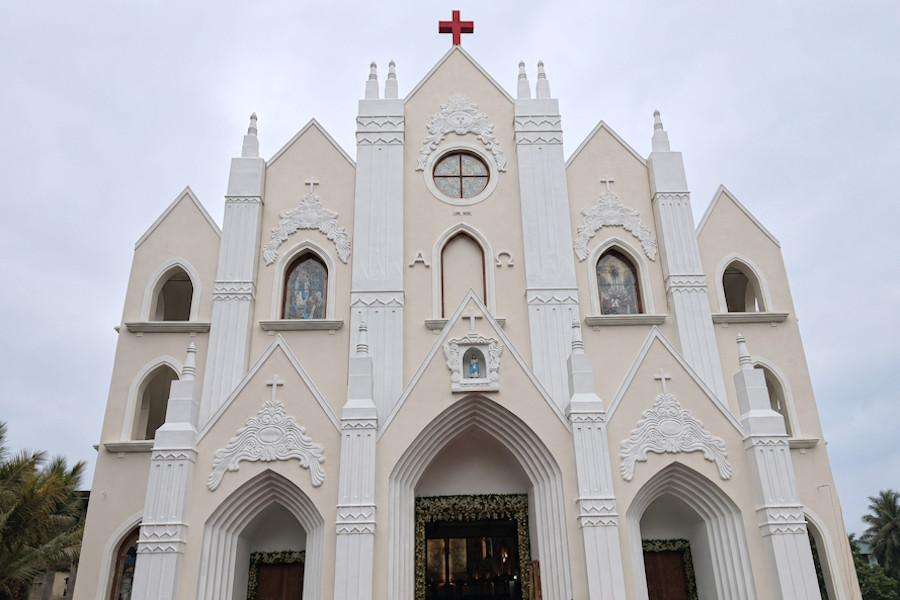
The Diocese of Sindhudurg
Located along the south-western coast of Maharashtra, the Roman Catholic Diocese of Sindhudurg was established on 5 July 2005, following its bifurcation from the Diocese of Poona.
Initially a suffragan diocese of the Archdiocese of Bombay, Sindhudurg became part of the newly established Metropolitan Province of Goa and Damão on 25 November 2006, when Pope Benedict XVI transferred the diocese to the new ecclesiastical province.
A Missionary Diocese
The Diocese of Sindhudurg is essentially missionary in character and serves a Catholic population of over 22,000 faithful through its parishes, substations and mission communities.
Although situated within Maharashtra, the Catholic community of the diocese has deep historical and cultural links with neighbouring Goa. Much of this heritage can be traced to migration from Goa more than two centuries ago. Consequently, Goan influences remain visible in the language, traditions, customs, religious practices and everyday life of many Catholic families across the diocese.
The pastoral mission of the Church, however, extends beyond the Catholic community. Through its educational, social, charitable and evangelising initiatives, the diocese seeks to serve the wider population of the region, particularly those living in rural and remote areas.
Geographical Territory
The Diocese of Sindhudurg covers an extensive territory of approximately 21,099 square kilometres. Its ecclesiastical jurisdiction comprises the entire districts of Sindhudurg and Ratnagiri, together with parts of Kolhapur district, excluding Kolhapur city. Within Kolhapur district, the diocesan territory includes the talukas of Ajra, Gadhinglaj, Panhala, Bhudargad, Kagal, Radhanagari and Shahuwadi.
Sawantwadi is one of the principal towns within the diocese, while Ratnagiri and Malvan are other important centres in its vast territory.
The Konkan and Sindhudurg
Sindhudurg lies in the southern part of the historic coastal region known as the Konkan, renowned for its long coastline, natural harbours, lush landscape and distinctive cultural heritage.
Historically, present-day Sindhudurg formed part of the larger Ratnagiri district. As the region developed, Ratnagiri district was divided for administrative convenience, and the separate districts of Ratnagiri and Sindhudurg came into existence on 1 May 1981.
The present Sindhudurg district comprises the talukas of Kudal, Malvan, Kankavli, Sawantwadi, Dodamarg, Vengurla, Devgad and Vaibhavwadi. Vaibhavwadi was subsequently formed through the transfer of villages from the former Bavda taluka of Kolhapur district.
The administrative history of the wider region stretches back considerably further. In 1819, South Konkan was constituted as a separate district, with its headquarters initially at Bankot and later at Ratnagiri. Following several administrative reorganisations during the nineteenth and twentieth centuries, Ratnagiri emerged as a distinct district. The former princely State of Sawantwadi was later incorporated into the district, and further changes created and reorganised several talukas.
Following the reorganisation of states in 1956, the region became part of Bombay State. With the creation of the State of Maharashtra on 1 May 1960, it became part of Maharashtra.
The Name “Sindhudurg”
The district takes its name from the historic Sindhudurg Fort, the magnificent sea fortress constructed under Chhatrapati Shivaji Maharaj near Malvan.
The name Sindhudurg literally means “Sea Fort”. Construction of the fort began on 25 November 1664 and was completed approximately three years later. Rising from the Arabian Sea, the fortress became an enduring symbol of the region’s maritime history and strategic importance.
Language and Culture
The wider diocesan territory has a population of approximately 5.79 million people and embraces a rich diversity of communities and traditions.
Marathi, Konkani and English are widely used across the territory. Among the Catholic community, Konkani occupies a particularly important place as the language of home, family, faith and cultural identity, while Marathi is commonly used for administration and interaction with the wider society.
The Catholic culture of the Diocese of Sindhudurg bears a distinctive Goan imprint. The migration of Catholic families from Goa over two centuries ago brought with it a rich inheritance of language, family traditions, customs, devotional practices, music and religious celebrations.
Over generations, this Goan Catholic heritage has taken root within the soil of the Konkan, developing its own distinctive expression while remaining closely connected to its historical origins. Today, this meeting of **Goan Catholic heritage and the culture of the Konkan** gives the Diocese of Sindhudurg a character that is both deeply traditional and distinctly missionary.